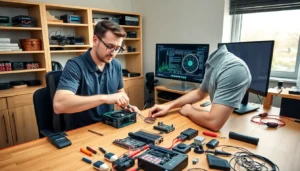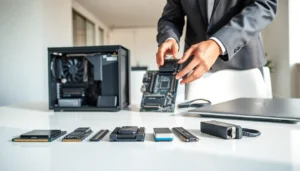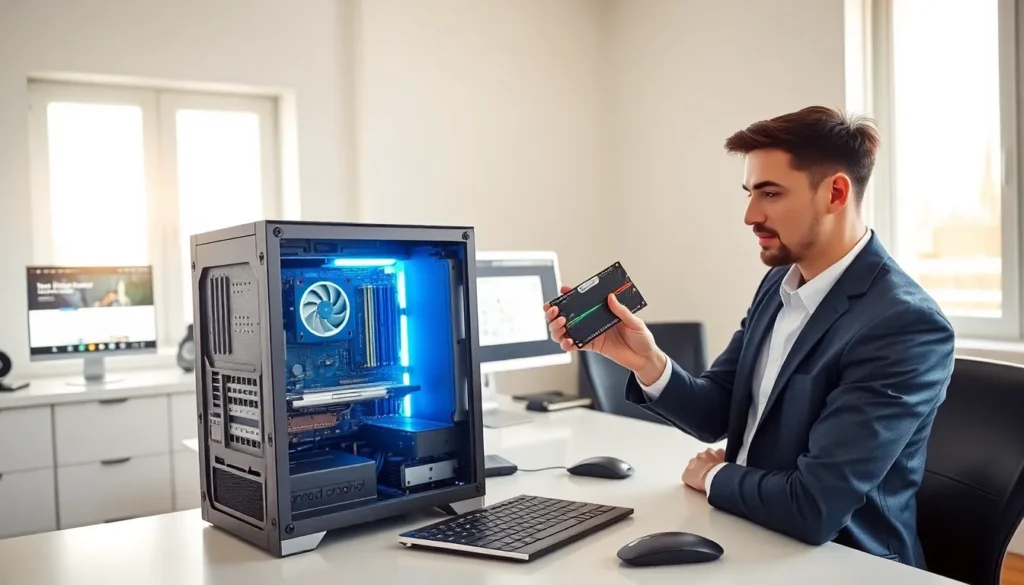

Hardware for beginners can feel overwhelming at first. Computers contain dozens of parts, each with a specific job. But here’s the good news: you don’t need an engineering degree to understand how your machine works.
This guide breaks down computer hardware into simple terms. Readers will learn what each component does, how parts work together, and what to consider when upgrading. Whether someone wants to build their first PC or simply understand what’s inside their laptop, this article provides a solid foundation.
Table of Contents
ToggleKey Takeaways
- Hardware for beginners starts with understanding two categories: internal components (CPU, RAM, storage) and external peripherals (monitors, keyboards, mice).
- The CPU acts as your computer’s brain, while RAM provides short-term memory for running programs and storage (HDD or SSD) holds your files permanently.
- All hardware components work together through the motherboard, so a balanced configuration performs better than overspending on just one part.
- Upgrading RAM or switching from an HDD to an SSD offers the most noticeable performance improvements for older computers.
- Always check compatibility before buying new hardware—CPUs require specific motherboard sockets, and RAM comes in different generations.
- Don’t overlook peripherals like monitors and keyboards, as they significantly impact your daily computing experience.
What Is Computer Hardware?
Computer hardware refers to the physical parts of a computer system. These are components a person can touch, the keyboard, monitor, internal circuits, and everything in between.
Hardware stands in contrast to software, which includes programs, apps, and operating systems. Software tells the hardware what to do. Without hardware, software has nothing to run on. Without software, hardware sits idle.
For beginners, understanding hardware starts with recognizing two main categories:
- Internal hardware: Components inside the computer case, such as the motherboard, processor, and hard drive
- External hardware (peripherals): Devices connected from outside, like monitors, keyboards, mice, and printers
Every computer, whether a gaming desktop, office laptop, or smartphone, contains hardware. The specific components may differ in size, speed, or power. But the basic principles remain consistent across all devices.
Think of hardware as a car’s engine and body. The software acts as the driver giving directions. Both must work together to reach a destination.
Essential Hardware Components Every Beginner Should Know
Several core hardware components appear in virtually every computer. Beginners should understand these parts first, as they form the backbone of any system.
The Central Processing Unit (CPU)
The CPU functions as the computer’s brain. It processes instructions from programs and performs calculations. Every action, from opening a web browser to running a video game, requires the CPU to work.
Modern CPUs contain multiple cores. A quad-core processor, for example, handles four tasks simultaneously. More cores generally mean better performance for demanding applications.
Two major companies dominate the CPU market: Intel and AMD. Both offer processors at various price points. Entry-level chips handle basic tasks like web browsing and document editing. High-end processors power video editing, 3D rendering, and intensive gaming.
CPU speed is measured in gigahertz (GHz). A 3.5 GHz processor completes 3.5 billion cycles per second. But, raw speed doesn’t tell the whole story. Architecture, cache size, and core count also affect performance.
Memory and Storage Basics
Beginners often confuse memory and storage. They serve different purposes.
RAM (Random Access Memory) provides short-term memory. When someone opens an application, the computer loads data into RAM for quick access. More RAM allows more programs to run smoothly at once. Most computers today ship with 8GB to 16GB of RAM. Power users and gamers often prefer 32GB or more.
RAM clears when the computer shuts down. It’s temporary by design.
Storage holds data permanently. This includes the operating system, applications, documents, photos, and videos. Two main storage types exist:
- HDD (Hard Disk Drive): Uses spinning disks to read and write data. Offers more space for less money but runs slower.
- SSD (Solid State Drive): Uses flash memory with no moving parts. Faster, quieter, and more durable than HDDs but costs more per gigabyte.
Many users now combine both: an SSD for the operating system and frequently used programs, plus an HDD for bulk storage.
Other essential hardware components include:
- Motherboard: The main circuit board connecting all components
- GPU (Graphics Processing Unit): Handles visual output and image rendering
- Power Supply Unit (PSU): Converts wall outlet electricity into usable power for components
- Cooling systems: Fans or liquid cooling that prevent overheating
How Hardware Components Work Together
Computer hardware doesn’t operate in isolation. Each component depends on others to function properly.
Here’s a simplified example of how hardware processes a task:
- A user clicks an application icon
- The storage drive sends program data to RAM
- The CPU reads instructions from RAM and executes them
- The GPU renders visual elements on screen
- The motherboard facilitates communication between all parts
The motherboard acts as a central hub. It contains slots and connectors for every major component. Data travels through circuits called buses, moving between the CPU, RAM, storage, and peripherals.
Speed matters at every step. A fast CPU paired with slow RAM creates a bottleneck. Similarly, an outdated hard drive limits how quickly programs load, even with a powerful processor.
This is why balanced hardware configurations perform better than lopsided ones. Beginners should avoid spending their entire budget on one premium component while neglecting others.
Cooling also plays a critical role. Hardware generates heat during operation. Excessive heat causes performance throttling or permanent damage. Adequate airflow, quality thermal paste, and proper fan placement keep temperatures manageable.
Tips for Choosing and Upgrading Hardware
Choosing hardware requires matching components to intended use. A student writing papers needs different specs than a video editor or competitive gamer.
Assess current needs first. What programs will run most often? How much storage does existing data require? Answering these questions prevents overspending on unnecessary power.
Check compatibility before buying. Not all hardware fits together. CPUs require specific motherboard sockets. RAM comes in different generations (DDR4, DDR5). Power supplies must deliver enough wattage for all components. Websites like PCPartPicker help verify that selected parts work together.
Consider future upgrades. Buying a motherboard with extra RAM slots or M.2 connectors allows expansion later. This saves money compared to replacing entire systems.
Start with impactful upgrades. For older computers, adding RAM or swapping an HDD for an SSD often produces the most noticeable improvements. These changes cost less than a new CPU or GPU but deliver real speed gains.
Don’t ignore peripherals. A quality monitor, comfortable keyboard, and responsive mouse affect daily experience more than internal specs suggest. Hardware for beginners isn’t just about what’s inside the case.
Research before purchasing. Read reviews, watch comparison videos, and check benchmarks. User feedback reveals real-world performance that spec sheets can’t capture.