
Hardware vs software represents one of the most fundamental distinctions in computing. Every device people use, from smartphones to supercomputers, relies on both components working in tandem. Hardware provides the physical foundation. Software delivers the instructions. Understanding how they differ helps users make smarter purchasing decisions, troubleshoot problems faster, and appreciate the technology they interact with daily.
This guide breaks down what hardware and software actually are, highlights their core differences, and explains how they collaborate to power modern devices.
Table of Contents
ToggleKey Takeaways
- Hardware vs software represents the core distinction between physical components you can touch and intangible code that provides instructions.
- Hardware includes tangible parts like CPUs, RAM, storage drives, and peripherals, while software encompasses operating systems, applications, and utilities.
- Hardware degrades physically over time and requires replacement, whereas software can be updated, patched, or reinstalled without changing physical parts.
- Neither hardware nor software functions independently—they work together in every computing task from typing documents to browsing the web.
- Understanding the hardware vs software relationship helps users make better purchasing decisions and troubleshoot tech problems more effectively.
- Operating systems serve as translators between application software and hardware, managing resources to ensure optimal performance.
What Is Hardware?
Hardware refers to the physical components of a computer or electronic device. These are the parts users can see and touch. If someone drops it and it breaks, it’s hardware.
Examples of Hardware
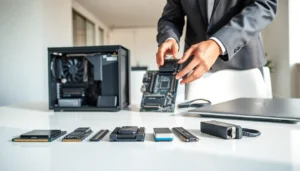
Common hardware components include:
- Central Processing Unit (CPU): The brain of the computer that executes instructions
- Random Access Memory (RAM): Temporary storage that holds data the CPU needs quickly
- Hard Drive or SSD: Long-term storage for files, programs, and the operating system
- Motherboard: The main circuit board connecting all components
- Graphics Card (GPU): Handles visual rendering for displays and games
- Monitor, keyboard, and mouse: Input and output devices for user interaction
Hardware vs software distinctions become clear here, hardware exists as tangible objects. A laptop’s screen, a server’s processor, a gaming console’s controller, all hardware.
Types of Hardware
Hardware falls into two broad categories:
- Internal hardware: Components housed inside the device (CPU, RAM, storage drives)
- External hardware (peripherals): Devices connected externally (printers, webcams, external drives)
Without hardware, software has nothing to run on. The physical infrastructure makes digital operations possible.
What Is Software?
Software consists of programs, applications, and operating systems that tell hardware what to do. Unlike hardware, software has no physical form. Users cannot touch it, but they interact with it constantly.
Examples of Software
Software comes in many forms:
- Operating systems: Windows, macOS, Linux, Android, iOS
- Applications: Microsoft Word, Google Chrome, Photoshop, Spotify
- Utility programs: Antivirus tools, disk cleaners, backup software
- Games: Everything from mobile puzzles to AAA titles
The hardware vs software distinction matters here because software represents code and data rather than circuits and chips.
Types of Software
Software generally falls into three categories:
- System software: Operating systems and utilities that manage hardware resources
- Application software: Programs designed for end-user tasks (word processing, browsing, editing)
- Programming software: Tools developers use to create other software (compilers, debuggers, IDEs)
Software can be updated, patched, or replaced without changing physical components. This flexibility gives it a significant advantage over hardware in terms of adaptability.
Core Differences Between Hardware and Software
The hardware vs software debate comes down to several key distinctions. Here’s a clear breakdown:
| Characteristic | Hardware | Software |
|---|---|---|
| Physical presence | Tangible, touchable | Intangible, code-based |
| Damage type | Physical wear, breakage | Bugs, corruption, viruses |
| Replacement | Requires purchasing new parts | Can be reinstalled or updated |
| Lifespan | Degrades over time | Does not wear out physically |
| Transfer | Must be physically moved | Can be copied or downloaded instantly |
| Cost factors | Manufacturing, materials | Development, licensing |
Durability and Maintenance
Hardware degrades. Hard drives fail after years of use. Batteries lose capacity. Screens crack. Software, by contrast, doesn’t wear out, though it can become outdated or incompatible with newer systems.
Maintaining hardware often means cleaning, replacing parts, or upgrading components. Software maintenance involves updates, security patches, and occasional reinstallation.
Development and Updates
Hardware changes require new manufacturing processes. Releasing a faster processor takes years of research and billions in investment. Software updates can happen overnight. Developers push patches, add features, and fix bugs remotely.
This difference explains why hardware vs software upgrade cycles differ dramatically. People replace phones every two to four years but update apps weekly.
How Hardware and Software Work Together
Neither hardware nor software functions independently. They form a symbiotic relationship essential to computing.
The Boot Process
When a user presses the power button, hardware springs to life first. The CPU receives electricity and begins executing instructions stored in firmware (a special type of software embedded in hardware). This firmware loads the operating system from storage into RAM. Once loaded, the software takes control, allowing users to interact with their device.
Ongoing Collaboration
Every action on a computer demonstrates hardware vs software cooperation:
- Typing a document? The keyboard (hardware) sends signals to the operating system (software), which displays characters on the monitor (hardware).
- Playing a video? The storage drive (hardware) sends data to the media player (software), which instructs the GPU (hardware) to render frames on screen.
- Browsing the internet? The network card (hardware) receives data, the browser (software) interprets it, and the display (hardware) shows the webpage.
Optimization Matters
Well-designed software maximizes hardware potential. Poorly optimized software wastes hardware resources. This relationship explains why some applications run smoothly on modest hardware while others struggle on powerful machines.
Operating systems act as translators between application software and hardware. They manage memory allocation, process scheduling, and device communication, ensuring everything works together efficiently.