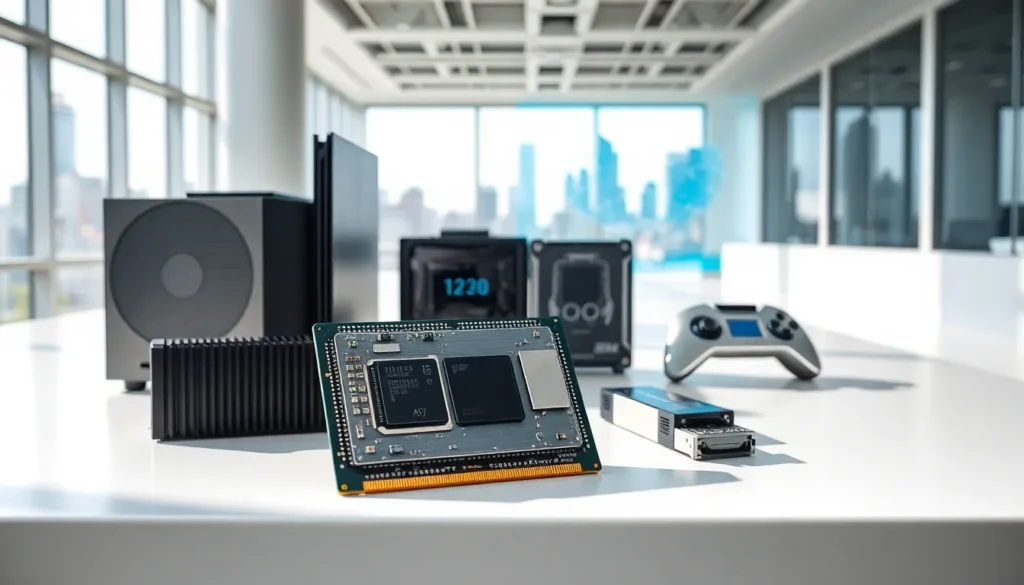

Hardware trends 2026 will shape how consumers and businesses interact with technology. The industry stands at a turning point, with processors getting smarter, storage getting faster, and energy efficiency becoming a priority. This year promises significant shifts in how devices are built, powered, and connected. From AI-driven chips to quantum computing breakthroughs, the hardware landscape is set for major changes. Here’s what industry watchers and tech enthusiasts should expect from hardware trends 2026.
Table of Contents
ToggleKey Takeaways
- Hardware trends 2026 will be defined by AI-optimized processors with dedicated NPUs that enable devices to run large language models locally.
- DDR5 RAM and PCIe 5.0 SSDs are becoming standard, delivering significantly faster speeds for gamers, creators, and enterprise users.
- Energy-efficient computing is a top priority, with ARM-based chips, liquid cooling, and immersion cooling gaining mainstream adoption.
- Modular and repairable device designs are reshaping consumer expectations, led by innovations like Framework laptops and compact mini PCs.
- Quantum computing is accelerating through cloud-based platforms, making experimentation accessible while researchers work toward error correction breakthroughs.
- Hardware trends 2026 also include foldable laptops, more powerful handheld gaming PCs, and smarter power supplies meeting 80 Plus Titanium standards.
AI-Optimized Processors and Chips
AI-optimized processors represent one of the most significant hardware trends 2026 will bring to market. Major chip manufacturers like NVIDIA, AMD, and Intel are racing to deliver processors built specifically for artificial intelligence workloads.
These next-generation chips feature dedicated neural processing units (NPUs) that handle machine learning tasks without taxing the main CPU. The result? Faster inference times, better power management, and smoother performance for AI applications.
Consumer devices will benefit directly. Laptops and smartphones equipped with AI-optimized chips can run large language models locally. This means faster response times and improved privacy since data doesn’t need to leave the device.
On the enterprise side, data centers are upgrading to AI-specific hardware at a rapid pace. Companies need processing power for training models, running analytics, and automating workflows. Hardware trends 2026 reflect this demand, with server-grade AI chips becoming more accessible and affordable.
Apple’s continued investment in its M-series chips shows how AI optimization is becoming standard. The company integrates machine learning accelerators directly into its silicon, setting expectations for competitors. Qualcomm and MediaTek are following similar paths for mobile devices.
Expect to see AI-optimized processors become the norm rather than the exception by year’s end.
Advancements in Memory and Storage Technology
Memory and storage technology will see notable improvements as part of hardware trends 2026. DDR5 RAM is becoming the standard for new builds, offering higher bandwidth and better efficiency than its predecessor.
Samsung, Micron, and SK Hynix are pushing DDR5 speeds beyond 8000 MT/s. This benefits gamers, content creators, and professionals who work with large datasets. Faster memory means applications load quicker and multitasking becomes smoother.
Solid-state drives (SSDs) continue their march forward. PCIe 5.0 drives are hitting the market with read speeds exceeding 12,000 MB/s. These drives reduce load times dramatically and improve system responsiveness.
Storage capacity is expanding too. Consumer SSDs with 8TB capacity are becoming more common and affordable. Enterprise solutions are pushing into the petabyte range for single arrays.
HBM (High Bandwidth Memory) deserves attention as well. This memory type, stacked vertically on processors, delivers exceptional bandwidth for AI and graphics workloads. Hardware trends 2026 show HBM3E becoming more prevalent in high-performance computing setups.
CXL (Compute Express Link) technology is gaining traction. It allows memory pooling across multiple devices, making data center resources more flexible and efficient.
The Rise of Energy-Efficient Computing
Energy efficiency has become a defining factor in hardware trends 2026. Rising electricity costs and environmental concerns are pushing manufacturers to build greener products.
ARM-based processors are leading this charge. Their architecture delivers strong performance while consuming less power than traditional x86 chips. Microsoft’s Surface devices and various Chromebooks already use ARM chips, and adoption is growing.
Intel and AMD are responding with their own efficiency improvements. Intel’s latest processors include efficiency cores that handle light tasks while using minimal power. AMD’s 3D V-Cache technology boosts performance without significantly increasing power draw.
Data centers are feeling the pressure most acutely. These facilities consume enormous amounts of electricity for both computing and cooling. Hardware trends 2026 include liquid cooling solutions becoming standard for high-density server racks.
Immersion cooling, where servers are submerged in special non-conductive fluids, is moving from experimental to practical. Companies like Microsoft and Google are testing these systems at scale.
Power supplies are getting smarter too. 80 Plus Titanium certification represents the highest efficiency standard, and more units are reaching this level. For consumers, this means lower electricity bills and quieter systems.
Emerging Form Factors and Modular Designs
Hardware trends 2026 include fresh approaches to device design. Modular computing is gaining momentum as users seek upgradeable and repairable devices.
Framework laptops have proven the concept works. Their modular design lets users swap ports, upgrade components, and repair damage without replacing the entire machine. Other manufacturers are taking notice.
Mini PCs are having a moment. Devices like the Intel NUC and ASUS mini PCs pack desktop-class performance into compact enclosures. They fit under monitors, behind TVs, or in tight spaces where traditional towers can’t go.
Handheld gaming PCs continue to evolve. The Steam Deck started this trend, and competitors like ASUS ROG Ally and Lenovo Legion Go are pushing boundaries. Hardware trends 2026 will bring more powerful handhelds with better battery life and display quality.
Foldable technology is expanding beyond phones. Foldable laptops and tablets with flexible OLED screens are entering the market. These devices offer larger displays that fold into portable packages.
Repairability is becoming a selling point. The right-to-repair movement has influenced manufacturers to design products that last longer and break less often.
Quantum Computing Progress
Quantum computing remains one of the most exciting hardware trends 2026 will advance. While practical quantum computers aren’t ready for everyday use, progress is accelerating.
IBM, Google, and Microsoft are investing billions in quantum research. IBM’s roadmap targets processors with over 100,000 qubits by the end of the decade. Current systems hover around 1,000 qubits.
Error correction represents the biggest challenge. Quantum bits are unstable and prone to interference. Researchers are developing new techniques to maintain qubit coherence for longer periods.
Cloud-based quantum computing is making the technology accessible. Companies can experiment with quantum algorithms through services like IBM Quantum, Amazon Braket, and Azure Quantum without owning hardware.
Real-world applications are emerging. Drug discovery, financial modeling, and cryptography stand to benefit most from quantum capabilities. Hardware trends 2026 include more partnerships between quantum companies and enterprises exploring these use cases.
Hybrid systems that combine classical and quantum computing are showing promise. These setups use traditional computers for most tasks while offloading specific calculations to quantum processors.